Abstract
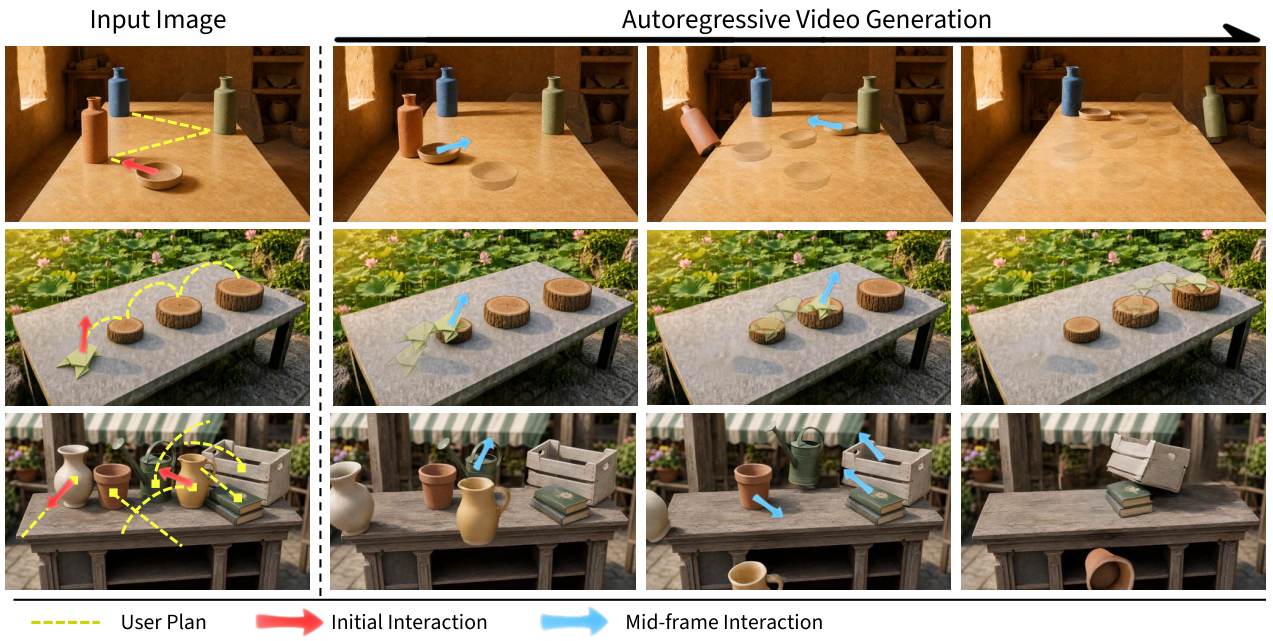
Interactive control for video generation is moving from coarse prompts toward fine-grained, physically meaningful manipulation of dynamic scenes. Yet existing controllable methods either require the full control schedule before generation starts, or use pixel-space signals that dictate object positions rather than physical dynamics. To address these limitations, we propose PhysStream, an autoregressive model for physics-grounded image-to-video synthesis that incorporates structured scene memory—positional maps and object tracking maps derived online from previously generated frames—and supports fine-grained motion control via sparse velocity-increment signals that encode physical quantities, letting the model learn the underlying dynamics. We train our model in two stages: a bidirectional model is first finetuned with motion-control conditioning, then a causal autoregressive model is trained with additional structured scene memory, further improving physical consistency. PhysStream enables interactive, mid-generation control over multi-object tabletop rigid-body scenes—a capability not supported by prior methods—reducing motion distribution distance (FVMD) by 33% and trajectory error by 12% over the strongest baselines on synthetic benchmarks, and is preferred by human evaluators in over 85% of in-the-wild comparisons.
Method Overview
Flexible Interactive Control
In-the-wild Comparison
Long Video Generation
BibTeX
@inproceedings{chen2026physstream,
  title = {PhysStream: Streaming Physics-Grounded Video Generation with
           Structured Scene Memory and Fine-Grained Motion Control},
  author = {Chen, Chuhao and Wonka, Peter and Wang, Chaoyang and
            Wang, Chen and Feng, Qiao and Tulyakov, Sergey and Liu, Lingjie},
  booktitle = {SIGGRAPH Asia 2026 Conference Papers},
  year = {2026},
  doi = {10.1145/3829340.3842176}
}